Sunday, September 18, 2022

Gold for Fools and Princes

I've been running the adventures in Journeys Through the Radiant Citadel as part of an open table campaign on my Discord. Without further ado, here's how "Gold for Fools and Princes," the sixth adventure, went for my "group." Only one player could make it to this session, so we played it one-on-one.

Contentious Beginnings

Horatio dreamed of a boy, destined to lead a revolution against tyranny, who was trapped underground. Fearing that the lad would never grow up to strike a blow against oppression, Horatio followed the hints provided by his dream to the mining town of Anisa, in Hazlan, where he discovered that the local gold mine had suffered a collapse and several miners were thought to be still trapped inside.

When Horatio arrived in Anisa, he was just in time to witness two Mulan noblemen, each with their supporters in the crowd, arguing in the town square over who would lead the expedition to free the trapped miners. The crowd was a mix of upper-class Mulan and Rashemi workers; each of the noblemen seemed favored by one of those groups. Horatio also met Uzoma, the dwarf overseer of the mine. She informed him that the two young noblemen had long been at each other's throats, particularly as both had been maneuvered by their respective families to marry Duchess Inaya--so they were both competing for her hand. Uzoma also told him that a survivor of the mine collapse claimed to have seen golden-furred monsters with multiple legs burrowing through the tunnels.

The nobles' squabbling was interrupted when a giant scorpion tore out of an alleyway, sending the assembled crowd into terrified flight. The two noblemen leapt down from their platform to fight off the beast, but Horatio was faster on the draw--he was soon hacking at the creature with his claws and deftly avoiding its stinging tail. 

This combat was instructive regarding the two noblemen. Lord Kirina, a hulking, axe-wielding noble clad in surprisingly utilitarian Rashemi clothing, was tall, imposing, and clearly a seasoned warrior. Lord Simbon, the smaller of the two who was dressed in the height of fashion, was clearly out of his element as he engaged the giant scorpion with his scimitar. Of course, neither could hold a candle to Horatio, who ripped the scorpion's head off and dashed it to the ground.

Extinct Monsters?

As soon as the creature was slain, Lord Simbon and Lord Kirina began arguing again--this time over who had acquitted himself the best against the beast. Uzoma stepped forward and interrupted their argument before it came to blows; she sent Lord Simbon with Horatio to consult with Father Kendrik, a priest of the Lawgiver, about the nature of the creatures that might await them in the mines, while she and Lord Kirina would head to the mines to supervise the excavation efforts.

On the way to see Father Kendrik, Horatio learned more about Lord Simbon. It was Lord Simbon's family's desire to see him wed to the wealthy and powerful Duchess Inaya, though he rued having to give up his decadent, womanizing lifestyle.

Once ushered into Father Kendrik's study in the Anisa Academy, a site of occult scholarship founded by Hazlik, they found the priest surrounded by a number of heavy tomes, scrolls, and papers--utterly engrossed in his work. He clearly regarded their visit as an intrusion. He dismissed talk of the monsters supposedly spotted in the mines; naming the creatures "aurumvoraxes," he informed them that the species had been hunted to extinction in ages long past. Father Kendrik also evidenced an obvious dislike for Lord Simbon.

Into the Dark

Their consultation with Father Kendrik now over, Simbon and Horatio arrived at the mine. Uzoma and the miners were too afraid of what might lay beneath, so it was left to Horatio, Simbon, and Kirina to venture into the dark in search of trapped miners. 

The bickering and sniping between Simbon and Kirina continued inside the mine, punctuated with violent encounters with the supposedly extinct aurumvoraxes. Eventually, Horatio discovered two things of note: a half-buried stone covered with script in the tongue of goblins that glowed with a rust-colored aura and a hasty bolthole in which the miners were hiding! Horatio and the two noblemen led the miners to safety, fending off one last attack by the aurumvoraxes. 

Into the Light

Despite having saved the miners, Horatio was unsatisfied with the way things had turned out: he felt that he had treaded the symptoms, but not the disease afflicting the mines of Anisa. After presenting the stone to Father Kendrik, the priest confirmed that the markings on it were in goblin script, and that the stone's purpose was to summon monsters. However, Father Kendrik noted that the stone itself wouldn't be enough to summon the monsters that Horatio had encountered--other, sympathetic, runes would have needed to be etched at the sites where the monsters had taken root.

Early the next morning, Horatio set off for the mine once more. With the monsters plaguing the mine now dead, he made a more leisurely exploration of the mines and discovered markings resembling those on the stone drawn on the walls in white chalk. Horatio rubbed out each of the markings, rendering them powerless. 

Figuring that whoever might be responsible for summoning the monsters would return to the scene of the crime, Horatio hid in a bunkhouse tent and was unsurprised when he spotted Father Kendrik approach and enter the mines. Horatio stealthily shadowed the priest, and observed that Father Kendrik made his way to each place he had found summoning markings. Father Kendrik carried a rag that he intended to use to destroy the evidence of his involvement.

Horatio confronted Father Kendrik, who admitted his part in the plot. He had engineered the mine collapse to provide an opportunity for Lord Kirina to prove his valor--and thereby increase his appeal in the eyes of Duchess Inaya. Of course, Father Kendrik had hoped to use Kirina to gain influence over the Duchess. Believing that Horatio now knew too much to live, the priest attacked, imbuing his staff with radiant power and summoning a sword of spiritual power. But it was not enough; Horatio killed him within the mines and hid his body among the rubble.

This left Lord Kirina to deal with. Horatio found Lord Kirina regaling the common folk of a tavern with tales of his own valor in the mines. Horatio brazenly challenged him to a fight. The commoners circled around the pair as they sized each other up. Lord Kirina struck mighty blows with his axe, but even his great strength was no match for Horatio, who knocked him unconscious with ease. 

Once Lord Kirina was imprisoned in a storage room beneath the tavern, Horatio explained all to the town guard. Horatio's allegations were confirmed both by Kirina's admission of guilt and papers found in the office of Father Kendrik.

Thursday, September 15, 2022

Review: Salted Legacy and Written in Blood

Now that I'm running the adventures in Journeys Through the Radiant Citadel, I'm going to be writing reviews of them informed by my actual play experience, much as I did previously with Candlekeep Mysteries. First up, "Salted Legacy" and "Written in Blood." Warning for those who plan on playing these adventures: spoilers ahead!


Salted Legacy

Written by Surena Marie

One thing I really liked about "Salted Legacy" as an entry-level adventure is that it eschews the "fighting kobolds or goblins in a cave" convention and instead drops the characters in the middle of a contentious social situation. That's honestly a nice change of pace for what is to all intents and purposes and entry-level adventure.

 Although there are a few occasions for combat, mostly in the market games, as written the scenario doesn't necessarily have to be solved with violence. The premise, exploring a vibrant night market in search of clues as to what is going on with a burgeoning feud between two food vendors and interacting with the market's sellers to get a sense of the forces at play, is pretty solid and offers a backdrop I haven't really seen done before.

That said, the night market games do feel a little game-y, especially since it's explicit that taking part in them is the only way to raise your renown high enough for the market folk to actually tell you anything important. I didn't mind that, but people with fragile senses of "immersion" could well be bothered by how this aspect of the adventure gamifies the renown rules in a blatant way.

Additionally, the adventure might be a little too "soft" in terms of stakes. The two rival families in the market are antagonistic to each other, but the text makes it clear that they will stop short of "harming" each other. I think that's a mistake; when I ran the adventure, I had the threat of them becoming violent hang in the air as an impetus to spur the players to action and as a possible consequence of their failure. Painting the two families as the Montagues and Capulets of the local marketplace raised the stakes considerably from "these two families yell at each other in public sometimes."

Also, I wanted to note one minor flaw that isn't impossible to rectify, but a DM might want to be aware of in advance: it's a little difficult to thread the needle on the third party being the real villain without either making it obvious who is inflaming the two families' mutual enmity or making the third party's influence too obscure to be picked up on during play.


Written in Blood

Written by Erin Roberts

There are a lot of great creepy details in this adventure that definitely fit the style of adventure I like to run. Additionally, crawling claws are often a generic "filler" monster in horror scenarios, but the way they take center stage here works well, particularly with the inclusion of the multi-armed soul shaker as the "evolved" or "greater" version of them.

I didn't really anticipate it, but the encounter where a pit opens beneath the wagon, creating a sinkhole that is then used as an ambush site by crawling claws, made for a pretty tense encounter. I don't think the characters were really in danger, but the set up made the players think that something catastrophic was possible, if not eminent.

Also, the abandoned farmhouses are given slight-but-creepy details that set them apart from one another, and the details are just enough to create an atmosphere of dread. My players wanted no part of those houses--which I take to be an element of successful design.

That said, the journey from the town to the farms at the frontier felt a bit linear. Things get better once they reach Kianna's farmhouse and begin exploring, but it would have been cool to see the possibility of picking alternate routes to get there. If you wanted to expand on this adventure, one obvious thing to do would be to create multiple approaches to the farmstead and let the players choose which way to go. Of course, you'd want to plan for different kinds of encounters along each of the pathways you devise. 

This may or may not be a negative aspect, depending on your preferences, but it's quite possible for the players to finish the adventure and still have only an inkling of what was going on with Kianna, Culley, the lake, and the monsters. Because so many npcs in the adventure "awaken" from their trances with no memories of their actions, there is a lack of material to piece together into a coherent picture for the players. 

In my opinion, this is actually fine for this particular adventure; as a horror-based scenario, it isn't out of line that they come away knowing that something awful was occurring, yet not completely assured that they understand the underlying cause of the terrors. In a horror-centric scenario, it's okay for uncertainty to linger--even after the adventure has been completed.

Tuesday, September 13, 2022

Sins of Our Elders

I've begun to run the adventures in Journeys Through the Radiant Citadel as part of an open table campaign on my Discord. Without further ado, here's how "Sins of Our Elders," the fifth adventure, went for my group on Discord.

Dramatis Personae

Captain Horatio Gurthus, human barbarian

Dwalin Codbiter, dwarf artificer

Through a Haze of Nightingale Bell

After the tragic events of the last adventure, Captain Horatio Gurthus was searching for a way to bring his comrade Brother Albany back to life. To that end, he teamed up with Dwalin Codbiter, who was looking for a way to send his departed uncle past the veil of death, as he was currently stuck in a half-life as a floating skull with many opinions on the doings of the living. The duo made their way to the fabled city of I'Cath, but upon arrival at the docks they were surprised to see that instead of a metropolis of endless wonders, they were instead in a squalid, poverty-stricken port of call.

They headed to the Yeonido ward, where they had heard the boundary between the land of the living and the land of the dead was particularly thin. Unfortunately, all they discovered was the run-down remains of a park in which homeless people were huddling around the base of a worn statue. When asked for directions, one of the homeless, an obviously diseased man with a wooden prosthetic nose strapped to his face, offered to taken them to the "Nightside" of the city--if they were willing to pay the price of his admission as well. 

They were surprised when the man took them to a sordid drug den, where the proprietor brought them each a wooden pipe packed with a substance called nightingale bell. As they smoked, they felt their bodies relax, then grow numb. As they begin to drift away into the intoxicant's revery, each of them closed their eyes. When they opened them, they found themselves standing again in the Yeonido ward, but instead of the squalor they had experienced prior, the city was now a bustling, glamorous metropolis filled with beautiful, decadent citizens.

Memory Holes, Government Work

Now in the Nightside of I'Cath, Dwalin and Horatio began to explore the mysteriously altered form of the domain. They were on a busy street, teeming with people, when a strange fog began to rise from the cobblestones. Out of the fog emerged a jade gargoyle with the contorted face of an angry human woman. The creature slew a passerby with its claws, but was soon slain in turn by our heroes. However, as the fog retreated and the gargoyle's remains melted into mist, a strange thing happened: the people who had witnessed the creature's attack looked bewildered for a moment and then went about their business as if nothing strange had occurred! 

Seeking answers, the duo met with Kun Ahn-Jun, a local magistrate. The harried Ahn-Jun bluntly asked them if they had had an unusual experience in the Yeonido ward and was relieved to hear that they remembered the gargoyle's attack. She told them that the strange fog and the monsters it brings was a regular occurrence, as was the people of the city immediately forgetting these bizarre incursions as soon as they were over. Until meeting Horatio and Dwalin, Kun Ahn-Jun seemed to be the only person in the city who could remember the murderous oddity plaguing the ward. 

Since they had the ability to remember the mists and their horrors, Ahn-Jun offered them a few leads that might intersect with their own interests: she told them of a construction site that had suffered multiple attacks, a royal park that had witnessed several attacks, and a tea house when two nobles had been found grievously wounded.

A Light in the Woods, a Cup of Tea

The pair decided to investigate the construction site first, and found it to be an area of the city that was expanding into the surrounding forest. Laborers were hard at work felling trees, while an overseer and two guards stood watch. While looking around the site, they found a cobblestone path leading into the woods; following it brought them to a moss-covered monument and a stone lamp whose flame shone with a strange blue light. Brushing the moss from the marble slab revealed it to be a memorial to a woman named Dae Won-Ha, a "Warrior of the People." Below her name was a long list of the civic accomplishments she had achieved as a magistrate of the ward. 

Taking the stone lantern with them, the pair found that the strange fog had returned and that the workers at the construction site were under attack by huge tigers with the faces of an angry woman--the same face that had encountered previously on the jade gargoyle! With the aid of the overseer and the guards, they managed to kill both creatures, but not before casualties were inflicted on the workers. However, as the fog receded, no one present save Dwalin and Horatio remembered the attack; the workers assumed their comrades had had "an accident."

Their next stop was the Phoenix Tea Shop. When they arrived, they were perplexed to discover that its proprietor was the same man who had taken them to the drug den in the squalid version of the city, but here in the Nightside he was a kindly and healthy man. The tea shop was decorated with a number of cups that had been signed by local celebrities and people of importance. When asked if he had a cup signed by Dae Won-Ha, he brought forth a matching pair of cups: one signed by Won-Ha and another signed by Young-Gi. 

The proprietor helpfully explained that Young-Gi had been a close friend of Won-Ha, that he was formerly an advisor to Tsien Chiang, the ruler of I'Cath, but that he was quite old now and lived in retirement in his mansion in the Estate Gardens area of the ward. He also revealed that although Won-Ha was once regarded as the savior of the Yeonido ward, she had died largely forgotten. Interestingly, when the teacup was brought into proximity with the stone lantern they had found earlier, it shone with a similar blue light. They took the teacup with them.

The Guilty and the Grand Guignol

Horatio and Dwalin used a letter from Kun Ahn-Jun to gain an audience with Young-Gi. Young-Gi was an elderly dragonborn gentleman whose red scales had faded to a rusty color. In contrast to the bustle and noise of the city, his house was a bastion of tranquility and serenity. Dwalin was initially suspicious that Young-Gi was summoning the monsters to preserve the memory of his departed friend, but Young-Gi was much more sanguine about the situation; as he reached the end of his own life, he had come around to the perspective that legacies are fragile things that cannot always be preserved. 

When presented with the teacup, a soft glow came from within Young-Gi's silk robes. He produced a gold amulet--Dae Won-Ha's badge of office as a magistrate, which she had given him as a token of their friendship. Young-Gi gave them the amulet in hopes that they might be able to use it to solve the mystery of the attacks on the city.

In the Park of the Elders, the pair decided to get a closer look at the statue of Tsien Chiang that a local drunken teenager had described as "creepy." The statue depicted Tsien Chiang as a beautiful paragon of wisdom; however, closer inspection of the legend inscribed at the base of the statue revealed that all of Dae Won-Ha's accomplishments had been ascribed to Tsien Chiang! The unnerving fog once again rose from the ground, and with it arrived the ghost of Dae Won-Ha, accompanied by two more jade gargoyles who bore her face.

The ghost of Dae Won-Ha complained of being forgotten by the people of ward; she threatened to take everything form the populace that she had poured her life into fostering. When presented with the lantern, the teacup, and the amulet, she began to believe that she had not been wholly forgotten. However, it wasn't quite enough to sate her. She offered Horatio and Dwalin a bargain: if they would find a way to bring her name back into public prominence and expose Young-Gi's role in Tsien Chiang getting the credit for her good works (because despite their deep friendship, Young-Gi was too loyal to the vile ruler of I'Cath), she would cease her attacks on the Yeonido ward, help negotiate for the return of Brother Albany's spirit, and usher Dwalin's uncle's spirit into the afterlife.

The pair settled on an ingenious solution: they commissioned a playwright to pen a play that cast the spirit of Dae Won-Ha as a boogeyman haunting the Yeonido district. This pleased Won-Ha as it reimagined her role, gave her prominence, and included Young-Gi's treachery as part of her villainous origin story. By the time the play premiered in the endless night of I'Cath's Nightside, it had become a thrilling Grand Guignol-style production with special effects overseen by Dwalin's keen eye for artifice. The play was a success; Won-Ha's terrifying name was now back on the lips of the people of her district.

She also kept her word. As Dwalin and Horatio dozed in their private box at the premier as the dose of nightingale bell wore off, they awoke in the city's squalid true self again--but the skull of Dwalin's uncle was now gone and Brother Albany's eyes shot open and he gasped with living breath!

Tuesday, September 6, 2022

Strahd Loves, Man Kills: Issue Eight Released, Issues Four and Five are Now Free!

It's hard to believe that I've managed to publish EIGHT issues of Strahd Loves, Man Kills! The new issue is now available from my Big Cartel site, and in my estimation it's an absolute brawler--probably my favorite issue yet. Here's what's inside:

Lurid Locations explores four locations you can add to your games: Maximilian's Waxworks, Briarhurst, Wildeacre, and the tower of Eisengraz.

Seeds of Evil details adventure seeds you can use to craft scenarios set in Ravenloft.

Portraits of the Damned details nonplayer characters such as an apothecary with a dark past, a vampire pugilist, a miner’s specter, a member of the Kargat, and Strahd’s bastard son.

Forged in Shadow adds three magical items to your potential arsenal of rewards.

Grim Phantasmagoria explains my goals, principles, and best practices for running adventures in Ravenloft.

Fatal Frames focuses on frameworks to unite your players’ characters into a cohesive group.

Cryptic Alliances revises the Ba’al Verzi cabal of assassins for use in your Ravenloft campaigns.

* * *

Also, if you're looking to fill in a gap in your Strahd Loves, Man Kills collection? Look no further! Here's a Big Cartel listing for the back issues that have been out of print until just recently. Please specify which issue you want a copy of in the comments when you order.

* * *


Finally, issues four and five sold out of their initial runs, which means the pdfs are now absolutely free for everyone. Please buy issues 6-8 so they too can sell out and become part of the community treasure chest!

Sunday, September 4, 2022

Wages of Vice

I've begun to run the adventures in Journeys Through the Radiant Citadel as part of an open table campaign on my Discord. Without further ado, here's how "Wages of Vice," the fourth adventure, went for my group on Discord.

Dramatis Personae

Captain Horatio Gurthus, human barbarian

Brother Albany Palmer, human monk

A Cry for Help in a Dark Alley Leads to a Job

Brother Albany and Captain Horatio dreamed of vibrant pink flowers growing in an orchard near a steaming jungle; the flowers began to rot before their eyes. The dream segued into a vision of the people of a town making a desolate exodus--with the flowers dead, there was no reason for them to stay in their home. Both awoke knowing that if they did not intervene, an entire town would suffer. And so they set off to a destination unknown, traveling into a bank of thick mist--emerging out of a jungle, with a town of gleaming white stone in view.

After taking their toll, the two guards at the gates of Zinda welcomed the pair to the town's March of Vice festival. Inside the town's walls, they found themselves on a wide street whose cobblestones have been painted gold. Even at an early hour, the streets were filled with revelers, vendors, and street performers. However, as they passed an alley they heard a cry for help. Investigating the sounds of distress, they found a dwarf slumped against a wall in the act of expiring.

Two guards, each wearing a gold-chased breastplate, entered the alley and accused the duo of killing the dwarf. Once they had examined the body and were subjected to some exculpatory quick-talking, their suspicions were allayed. The guards were joined by a tall elf woman in a sumptuous orange gown, her hair pulled back into dreadlocks. She introduced herself as Samira Arah, one of Zinda's "Kings of Coin," a consortium of guild leaders who are the de facto rulers of the town. 

Sizing them up as experienced adventurers, Samira wished to hire Horatio and Brother Albany. Although she was the leader of the jeweler's guild she commanded the guards of the Silent Verse (the soldiers with fancy breastplates they had spotted throughout Zinda), she had need of agents who were unknown to her compatriot Kings of Coin. In particular, she wanted the pair to investigate a recent spate of attacks on the children of the Kings of Coin. She explained that the dead dwarf was Jacopo Ain, the son of Massimo Ain--the leader of the smith's guild. Indeed, on the previous day Zenia Ruba, the daughter of Nargis Ruba, the King of Coin who oversees taverns and entertainment in the town, had been attacked in the street.

Fearing that a conspiracy was afoot, Samira wanted the duo to talk to Zenia and find out what exactly had happened. Believing that the girl was being kept under her father's watchful eye at a tavern called the Thornapple, Samira sent them in search of an audience with her.

Death by Pestle

On the way to the Thornapple, a stout women in yellow and green jostled Brother Albany as she quickly made her way through the crowd. Immediately after, they heard a cry of pain from behind them. They saw a man from a herbalist's stall bludgeoning a fallen teenager with a pestle; the herbalist had a crazed look in his eye and swung the pestle with a madman's strength. Intervening, the pair managed to subdue the herbalist, but not before he brought the pestle down with fatal finality on the prone man's head. 

After the brief brawl, they learned that the victim was Arel Avim, son of Solenn Avim, the King of Coin overseeing the weaver's guild. During this sad episode, they also made the acquaintance of Captain Adann, a self-proclaimed "Bloodletter," a member of a political faction that wishes to see the overthrow of the Kings of Coin and the imposition of a more egalitarian economic system in Zinda. Furthermore, a girl informed them that she had seen a stout woman in green and yellow talking to the herbalist just prior to the attack.

Near Death by Stiletto

When they arrived at the Thornapple, they found it to be a well-appointed tavern already crowded with patrons. They were greeted by Nargis Ruba, the King of Coin responsible for entertainments and drinking establishments throughout Zinda. The Thornapple's stage was being set for a performance; as Brother Albany engaged Nargis in conversation to distract him while Horatio approached Zenia, Nargis told him that his tavern was proud to host a series of performances by Diva Luma, a famous singer from Kartakass. 

Horatio flashed the insignia that Samira had given him, causing the two members of the Silent Verse flanking the girl to depart. Zenia was impressed that Horatio was an adventurer, an interest he parlayed into getting her story. She told him that she had been shopping when she suddenly felt quite ill, and then suddenly her servants began attacking her and each other. She recalled seeing a cloud of pink ash around them when the melee broke out, and that a woman in green and yellow had bumped against her just before her servants went mad!

Just then, Diva Luma took to the stage with a cohort of dancers and musicians. The singer reached into a pouch by her side and threw a handful of pink glitter into the air. As it descended upon her, her stage-bright smile turned into a look of malice; she removed her stiletto heels, brandished one as a weapon, and began to run toward Zenia! Horatio positioned himself between the girl and the diva; he, Brother Albany, and eventually the two Silent Verse guards, managed to subdue the crazed singer, but only after being stabbed repeatedly by her heeled shoe.

Once Diva Luma had been knocked out, Nargis rushed to his daughter's side. Clasping her to him, Nargis began to weep only. When pressed, he admitted that the attacks on the children of the Kings of Coin were "his fault." He confessed that the six Kings had made a pact with a witch from the jungle known as Proud Edun. Proud Edun had brought them prosperity, but of course there was a price to be paid: the six Kings were meant to bring the witch their firstborn as payment. To avoid paying their debt, Nargis hatched a plan to lure Proud Edun into a "meeting" that was actually an assassination. 

One of Diva Luma's entourage reported that the bag of glitter, which was found to be tainted with pink ash, was given to her outside by a woman wearing yellow and green. The woman even gave her name, Kala Marbarin, which Nargis recognized as the name of Proud Edun's daughter who was presumed lost to the jungle years earlier. Apparently she was back and looking to avenge her mother.

A Side Trek, A Parade, Death Rears Its Ugly Head

Brother Albany and Horatio decided to venture into the jungle to find Proud Edun's hut to see if it would reveal any clues to Kala's plan. The hut had been recently inhabited, and the cauldron evidenced pink residue from whatever substance Kala had cooked up to turn innocent people into violent madmen. Also, they found a list of names (each of the Kings of Coin, save for Samira Arah) scratched into the dirt floor of the hut.

When they returned to Zinda, they discovered that a parade down the golden road was now underway. Revelers were begging for beads and sweets from the Prince of Vice, a masked man who they quickly figured out was Azra Nir--son of Amos Nir, one of the Kings of Coin. Spotting a flash of yellow and green in the crowd, it was apparent that Azra was to be the next victim.

Kala emerged from the crowd and ensnared the Prince of Vice's parade float with vines conjured from the pavement. Horatio and Brother Albany rushed to engage her and protect the Prince of Vice. However, Kala threw a fistful of pink powder into the faces of Azra's guards, turning them into insanely violent allies. 

When Kala was taken down, a smokey substance issued from her nose and mouth--it coalesced into the spectral form of her mother, the witch Proud Edun! Proud Edun's wraith attacked Brother Albany with a fury--killing him outright. She then raised his shade as a specter under her control. Horatio had no recourse save destroying both hateful spirits.

The danger to the children of the Kings of Coin now dealt with, Horatio collected his reward, bought a horse and wagon, and had Brother Albany's body safely ensconced in a coffin. Consulting with the Kings of Coin set him on a possible path to Brother Albany's resurrection: he was told to seek out the fabled land of I'Cath, which will be the basis of the next adventure.

Friday, September 2, 2022

A Young Person's Guide to the Gothic, The Tindalos Asset, and More

Things that brought me delight in August, 2022:


Richard Bayne, A Young Person's Guide to the Gothic

Richard Bayne's A Young Person's Guide to the Gothic is exactly what it purports to be: an introduction to Gothic fiction intended for a younger audience. Bayne explores the Gothic by breaking it down intro discreet conventional units, such as Setting, Scenery, Plot Devices, and Characters. Interspersed throughout the explanations of key Gothic concepts are copious examples pulled from Gothic texts. The book also includes several complete short stories, by the likes of Poe, Charlotte Perkins Gilman, and M.R. James, to illustrate what the Gothic looks like in action. The wonderful cover and spot illustrations were done by Richard Sala; Sala's art really is a perfect choice for this sort of thing.

As someone who is a bit persnickety about how the Gothic is taught, I do have some criticisms. The book could have used another editorial pass. Sometimes the excerpts used as examples go on for far too long; the concept they're meant to highlight can get lost in the amount of text that's used. Oddly, the Harry Potter series is frequently referenced. I understand the tactic here--use a "touchstone" that will be immediately recognizable to a young audience--but I think that dates the book straight out of the gate. Subsequent generations are likely to be less and less familiar with Harry Potter, which renders any utility mute going forward.

My criticisms aside, this really is a wonderful introduction to the Gothic. The short fiction that is included, some of which I hadn't read before, is nearly worth the price of admission on its own.


Caitlin R. Kiernan, The Tindalos Asset

The Tindalos Asset is the third book in Caitlin R. Kiernan's Tinfoil Dossier series, in which Burroughsian spies deal with the cosmic threat posed by Lovecraftian horrors. I enjoyed the previous two installments, Agents of Dreamland and Black Helicopters, but The Tindalos Asset might have hit me at just the right time; I didn't know I needed a shot of spycraft and weird horror, but the novella delivered it anyway.

The Tindalos Asset focuses on an "occult assassin" who has been drawn out of hazy, drug-addled retirement to stop the machinations of a cultist with a powerful connection to Mother Hydra. What I really enjoy about the structure of the novella, which offers brief peaks into the story's even across a wide range of time periods, is that it gives you a palimpsest of clues and inklings to work with rather than a straightforward spy thriller. 


Marilyn Ross, The Curse of Collinwood

The Curse of Collinwood marks a significant departure from the Dark Shadows books Marilyn Ross had penned previously. The opening pages quickly upend several situations that had been simmering since the first book. Ernest Collins, a character invented for the book series to be Victoria Winters's love interest, is quickly killed offstage; Elizabeth Stoddard discovers that her "dead" husband is actually still alive, which causes her to suddenly thaw out and take on a fairly different persona; Carolyn has had a breakdown. So much change is glossed over so quickly that it's a bit dizzying.

Another big change in this volume is that the supernatural is actually real! Previous books in the series go in for an Ann Radcliffe/Scooby-Doo effect where any supposed specters or ghouls are exposed as mundane criminality in the end, but not The Curse of Collinwood, which features Derek Collins and his bride returned to haunt Collinsport as zombies!

Also, it's worth noting that Victoria goes from mourning Ernest to kissing Burke Devlin at every chance in record time.


Scare Tactics

Scare Tactics was a short-lived DC comic from the 90s about a gang of monsters on the run. To remain under the radar, they form a band and go on tour so they aren't sitting ducks for the shadowy organizations that are after them. I'm not sure how grabbing the spotlight is supposed to keep them cloaked in secrecy, but that's the premise we're rolling with.

I hadn't actually heard of Scare Tactics until last month, but I was able to buy the full run at less than cover price. Since I love a monster mash, this one felt like a no-brainer to me. It's not a "deep" comic by any means, but I love the idea of rockin' monsters getting into scrapes with men in black, vampire hunters, and hillbilly werewolves. Unfortunately, it was canceled after its twelfth issue. The series does try to wrap itself up in the face of doom, to predictably bizarre results. 


Journeys Through the Radiant Citadel

Journeys Through the Radiant Citadel feels like a very special book of D&D adventures, unlike anything that has come befpre, so I hope it's getting the attention it deserves and hitting tables for actual play. Written by a cohort of POC, many of whom don't have long list of previous credits, the book promises to offer fantasy scenarios inflected with cultural influences far from the usual conventions, images, plots, and tropes most often found in D&D. The adventures have a wide range of themes, and a wider than usual range of ways to complete them. 

Of course, the true test of any book of adventurers is actual play at the table, but the content is fascinating enough that I was looking forward to running them back to back as a campaign, much like I did with Candlekeep Mysteries. As of this writing, I've run three of the adventures in the book; so far, so good.


Allison Saft, Down Comes the Night

I picked up Down Comes the Night because it showed up on a bunch of "best new Gothic novels" lists, so I was surprised that it started off as that particularly YA genre of "young people at war in a fantasy world," not unlike Shadow & Bone or Wicked Saints. The novel focuses on Wren, a combat medic who has trouble following orders and who got redeployed to a mining operation, where she will clearly die, as a punishment. She goes AWOL to a neighboring nation to heal a nobleman's servant of a mysterious ailment. And that's where things get Gothic; she arrives at Colwick Hall, a crumbling manor that is rumored to be haunted and owned by an infamous dandy. 

(One interesting deviation from the formula: instead of the manor being an artifact of the past, it's actually more modern than the protagonist is used to in that it has electricity.)

Down Comes the Night isn't perfect. There a few plot elements that are either too convenient or blindingly obvious. For example, at one point the protagonist needs to find a key...the location of which has been pointed out in nearly flashing neon several times, but gosh she just can't figure out where it might be. Still, this one cracks along and has plenty of people wandering around with candelabras. 


Chris Dows, Colin Clayton, and Horus, Autumn: Terror in the London Underground

Originally published as a three-issue series by Caliber Entertainment, Autumn: Terror in the London Underground is a tale of obsession and revelation. During the Blitz, a young boy has to shelter in the Underground as bombs fall on London; this fateful night, a killer begins stalking the city, returning to his grisly crimes every autumn. The boy becomes fixated on the murders, well into adulthood. When the killings come close to home and involve him personally, he ventures into the depths of the Underground and discovers the strange nature of the murderer and also has a moment of terrible revelation about himself. The black & white art, combined with the subject matter, reminded me a bit of From Hell, but the horrors of Autumn are all of their own piece.


Julia Gfrorer, Tartarus

I didn't read much in the middle stretch of the month (always a bad sign), but Julia Gfrorer's latest comic zine Tartarus came in the mail, so I made an effort to read it straight away. Although the visuals don't really present any bold surprises or unexpected moments, as a whole the comic is a  pretty interesting take on the role of AI in art and having a personal, aesthetic commitment to meaning in the face of so many shortcuts and low-stakes Big Ideas.


The Sandman

Although Netflix's adaptation of The Sandman isn't an unqualified success, it deserves a place in this month's list for actually managing to film a comic I had previously considered possibly unfilmable. 

The show is mostly faithful to the source material, save for where it makes deviations to separate the story from the larger DC universe. (For example, Johanna Constantine is substituted for John Constantine, and much of Lyta Hall's storyline is altered.) Unfortunately, those changes don't always work particularly well. Additionally, there are a couple casting choices that didn't do it for me; personally, I find Patton Oswald extremely distracting as Matthew the raven.

Thing seem to be set up for the Season of Mists storyline next, but with streaming services backing away from expensive productions at the moment, who knows if we'll get it. Still, it was nice to see at least a nice chunk of Sandman's early plotlines.


Christopher Buehlman, Between Two Fires

I'll have more to say about this on the next episode of Bad Books for Bad People, but suffice to say that Christopher Buehlman's Between Two Fires challenges the notion of grimdark fantasy by asking "Why not just think of this as horror set in an earlier era?"

Concerning the journey of a fallen knight, a troubled priest, and a divinely haunted girl through the hellscape of France during the Black Death and Hundred Years' War, Between Two Fires is a travelogue of human degradation. It probably isn't for everyone, but it's probably for the freaks who read this blog.


Spelljammer: Adventures in Space

Often wrongly predicted, if not demanded, every time a new D&D product was about to be announced, 5e's update of Spelljammer is finally here. And generally, it's pretty cool. The ship designs are awesome, the new races present the right kind of Star Wars cantina vibe, and new monsters are always welcome--even if they do split the difference between silly and Lovecraftian.

If there's one failing in the set, it's that its format (three hardcover books and a screen in a slipcase) promises an abundance of riches that it doesn't quite deliver on. As a concrete example, there are rules for ship-to-ship combat, which feel essential to the milieu, but they're a cut-down version of rules we've already seen in Ghosts of Saltmarsh and Descent into Avernus. There is a feeling of squandered potential there; we could have a nice chunky section of modifications and magical weapons that ships can be outfitted with, but it's almost all the same catapults and ballistae on every type of ship.

No comment on the adventure, as I haven't read it. Someone might be running it, so I have to abstain for a bit.


The Annotated Dracula

I undoubtably have more copies of Dracula than any one person strictly needs, but my girlfriend bought me this amazing copy of The Annotated Dracula. Not only does it reproduce the entirety of Bram Stoker's novel, it also includes extensive illuminating annotations and some wonderfully otherworldly art by Wilifred Satty. Just an amazing volume all around, and now it is mine!


Eric Powell's The Goon Bunch of Old Crap An Omnibus Volume 3

Since I started my re-read of The Goon, I've been curious when I'd run across the point where I had bailed on the comic previously. It turns out that the breaking point for me was somewhere in the issues collected in this third omnibus. 

The story isn't bad by any stretch, but this does feel like the slowest, perhaps most protracted, of The Goon's arcs. Still, this time it won't kill my momentum--onto omnibus four next month!


Soul Arts

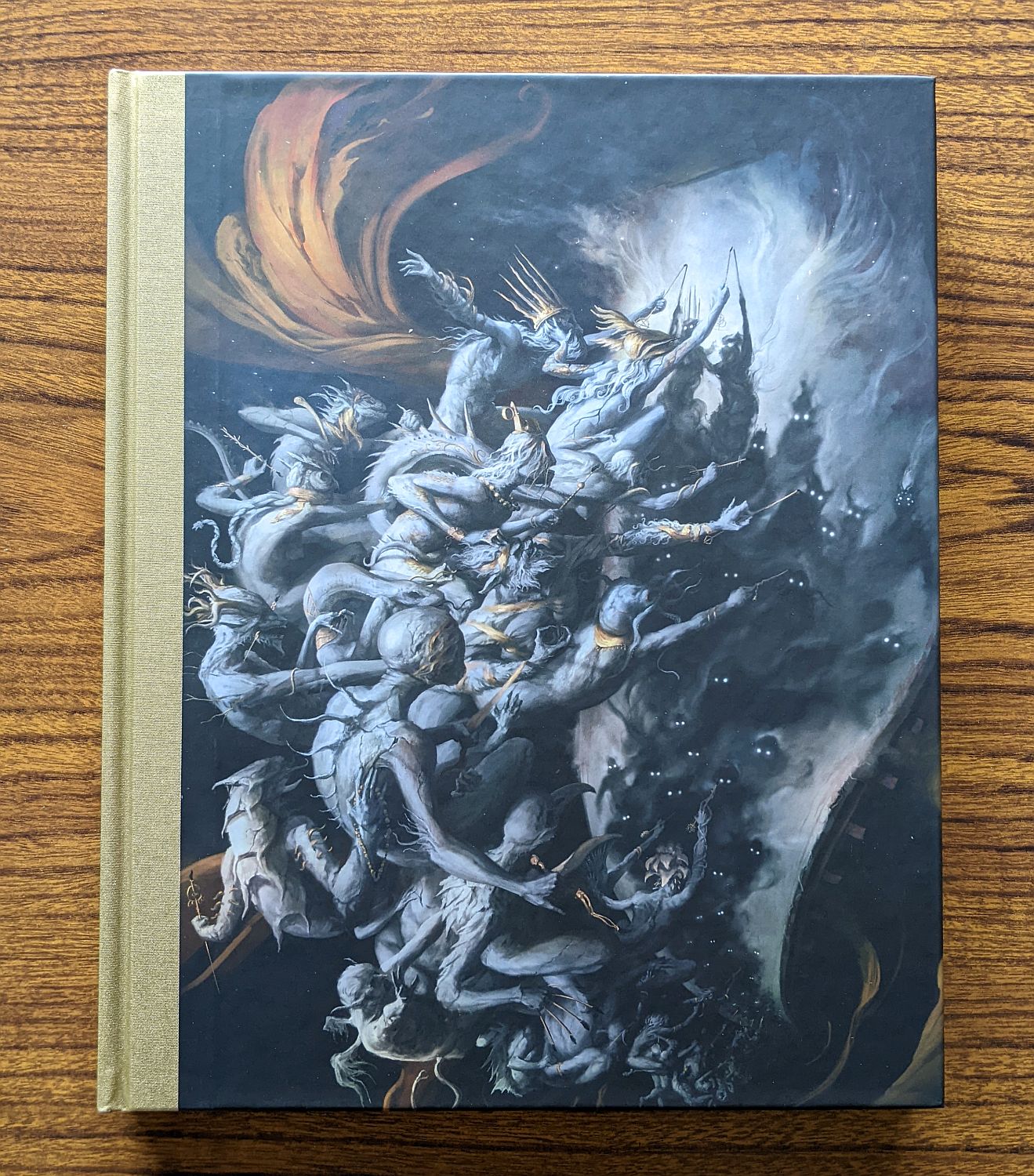
Soul Arts is a wonderfully deluxe art book that was crowdfunded by VaatyaVidya, one of the foremost Soulsborne lore youtubers. The book collects fan art from the various art competitions that VaatyaVidya has hosted over the years, with themes based on prompts such as "Imagine what Bloodborne II would be like" or "Invent new prosthetic weapons for Sekiro." Although the art in the book is "fan art," don't suppose for a second that it's amateurish; the pieces in this book are as good as any of the official art from games like Elden Ring or Dark Souls.


The Invitation

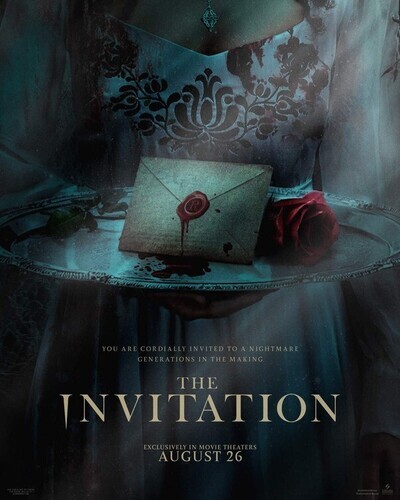
Going to the movie theater is a rarity for me these days, but I had an afternoon off and since there was a new horror movie just out...I was off to see The Invitation. The Invitation is a fun little riff on Dracula; a recently orphaned woman discovers that she's related to a posh British family, who are a little too eager to meet her. Of course, she's being lured into a dark familial mystery.

Nathalie Emmanuel turns in a credible performance as a leading actor, and the film has a nice, creepy Gothic atmosphere. I don't think this movie will blow anyone away, but I think it's a bit better than many critics are saying.


Halloween Masks

We got these on our first pilgrimage of the year to the Spirit Store. The best time of the year is fast approaching!