Wednesday, July 13, 2022

Monsters Attack! Issue Three

Monsters Attack! was a short-lived, magazine-sized comic put together by the then-editor of Cracked magazine. Each issue features a number of horror comics, as well as articles about horror movies and all things gruesome. I got my hands on the first issue when it debuted, but the pharmacy I bought it from never seemed to get the following numbers. Now that I have a copy of the Monsters Attack! Ultimate Collection, I plan to go through the series' five-issue run and briefly review the comic content from each issue. I've covered the first issue here and the second issue here, so let's move on to the contents of the third issue.


"A Boy's Life"

Story by Mort Todd, art by John Severin

An Eddie Munster-looking vampire boy finds himself in a new town, and all the potential meals are terrified of him even though they have no way to know that he numbers among the undead! So, he takes the easy way out and attacks a crippled boy. Yeah, you read that right, a crippled child. Unfortunately, the crippled boy had polio...which is apparently transmissible to vampires. This also explains why everyone was running away from him; the townspeople were scared of polio-bearing strangers!

"Face It"

Story and art by Steve Ditko

A mad scientist invents a device that allows him to take on the appearance of a wealthier man so he can withdraw money from said wealthy man's bank account. Everything goes off without a hitch, until the mad scientist's robotic servant tires of playing second-fiddle to a two-bit criminal, seizes control of the face-manipulating device, and turns its master into a cartoonish grotesquerie.

"Cells"

Story and art by Rurik Tyler

This is a wild one. An incarcerated hypnotist has mastered the art of manipulating the biological cells of the human body. He transforms three of his fellow inmates into monstrous forms to aid in his jailbreak. Ultimately, he escapes the prison by changing himself into a bizarre, pterodactyl-like form and flying away. The narrator...enlists the aid of the Audubon society to bring him to justice (!!!). This story really makes very little sense, but you can't help but be entertained.

"The Wake of a Monster"

Story and art by Pat Boyette

An invisible demon, who doesn't really understand what he is, wanders around snapping necks and otherwise causing trouble for humanity. This is a weird, comedic take on...something. The image to the left amusing me unduly, for reasons I cannot adequately explain.


"The Daemon"

Story by John Arcudi, art by Gene Colan

A cop is aided by the FBI in tracking down a seemingly supernatural killer. It turns out that one of the FBI agents is a werewolf. Fight fire with fire, I suppose! This is another story in the Monsters Attack! run that makes excellent use of moody black and white art.

Sunday, July 10, 2022

Flash for Freedom!

Episode 57: Flash for Freedom!

George McDonald Fraser’s long-running Flashman series follows the adventures of Sir Harry Paget Flashman, a self-confessed scoundrel, as he navigates the landscape of the mid-nineteenth century. Jack and Kate jump in at the deep end with Flash for Freedom, the third book in the series that finds Flashman enmeshed in the North American slave trade. Buckle up for a tale that leans all the way into the permissive pulp style of the early 1970s!

Is the past really a different country? At what point does an antihero tip over into just plain old villain? Just how much atrocity can be forgiven if a dude has the right kind of facial hair? Find out the answers to these questions and many more in this episode of Bad Books for Bad People.

As promised, here’s a link to the Lady Klingon ad Kate mentions in the episode. 

Monday, July 4, 2022

Waste, Foreverglade, Mordew, Tide Turns Eternal, and More

Things that brought me delight in June, 2022:

Andrew F. Sullivan, Waste

I have learned that when a thing is good, the kids say it "slaps." Well, Andrew F. Sullivan's Waste slaps pretty damn hard, both in the sense of being a great read and in the sense that it pummels you down as you progress through its tale of down-and-out dirtbags in the fictional post-industry town of Larkhill, Ontario. It's so gritty and grimy that I felt like I needed to take a shower every fifty pages or so. On the other hand, it's also comforting to know that Canada has burnt-out towns as fucked up as the ones I grew up in during approximately the same era.


Worm, Foreverglade

I'm sure the name of the band contributes to the association, but to my ears Worm makes metal that Kyuss, the Worm That Walks, would enjoy. The sound on Foreverglade is a mangled amalgamation of Floridian death metal and funereal doom; there's something undeniably earthy and swampy about the album, and you can practically smell the profane ritual that Worm's music conjures up in your mind's eye.


Alex Pheby, Mordew

At first I thought I had made a terrible mistake by picking up Mordew because the story doesn't start until page twenty, after a lengthy three-page dramatic persona and then a list of things that are present in the novel, and the last hundred-plus pages are a fucking glossary and essays, but wonder of wonders the writing is solid and engaging throughout. The first bit feels like a Dickensian dark fantasy (emphasis on the dark) about a gang of urchins pulling heists at the behest of a cruel criminal overlord in an apocalyptic city that wouldn't be miscategorized among a selection of New Weird-inflected urban settings. That gives way, after a personal calamity of sorts, to the main character's dubious "training" in magic--which feels like it's mostly propaganda for the wizard who rules the city. Things get buck wild from there; anything more I could say would venture into hard spoiler territory. 


Dream Unending, Tide Turns Eternal

The "Peaceville Three" sound pioneered by Paradise Lost, My Dying Bride, and Anathema has been hugely influential on the doom genre; you can hear elements of their classic works echoing across the whole of doom metal. And yet, it's interesting that there are so few bands that carry on in the same vein. Enter Dream Unending, a project that has made it their mission to continue the lush, yet crushing and melancholic, sound found on records like Draconian, Turn Loose the Swans, and Serenades. That isn't to say that their sound is derivative; Dream Unending have their own vital spirit, but fans of that bygone era of doom should definitely seek out Tide Turns Eternal.

Yana Toboso, Black Butler XXXI

My long wait is over, a new volume of Black Butler has arrived in translation! I have to say, volume XXXI has one of my favorite covers thus far in the series' lengthy run. The interior content was also well worth the wait, as the first bit, which concludes the Yorkshire arc, has lots of action centering on my two favorite characters. Once that has concluded, we get the start of a new arc about the nefarious doings in a hospital for war veterans. I'm enjoying the origin stories for all the members of the Phantomhive staff, so I'm looking forward to learning more about the cook and his time as a soldier. But can I survive the wait for another volume? We must persevere in these trying times. 


Iron Maiden, all of the records up until Bruce Dickinson's departure

Maybe it was the release of the Street Fighter 6 trailer that did it; back in the day, when we used to crawl from one arcade to another, Iron Maiden was often the soundtrack of the night because one of the guys in my little friend group was a huge Maiden fan. Who knows, maybe Iron Maiden will be the soundtrack to my Dirtbag Summer of chili cheese Fritos and cans of Old Milwaukee. Anyway, all of this is to say that I get the appeal of Iron Maiden now more than ever.


David Lindsay, The Haunted Woman

Fans of weird fiction might recognize the name David Lindsay from his "obscure classic," A Voyage to Arcturus, but The Haunted Woman is more in the Gothic mode, even though it remains solidly weird. If anything, I might argue that it prefigures the whole hauntological and folk horror phenomenon that would arrive later. 

Initially, I found myself interested in the triangular relationship at work in the novel: a courting couple and the woman's widowed aunt. Their relationships are all strained in some way. What brings them together is a house the aunt may want to buy, a house that is rumored to have a spectral staircase leading nowhere, like a ghostly Winchester House. But the strange stairs, that are not apparent to everyone, do lead to a mysterious chamber where society's social rules fall away and the true passions of the heart are revealed--as the engaged woman and owner of the house discovered when they venture into the shadows together. Ultimately, The Haunted Woman is a story about passion, the tragedy of romance, society's rules, and sacrifice.


Blind Guardian, every album from Battalions of Fear to Nightfall on Middle-Earth

As with Iron Maiden above, Blind Guardian was another favorite of my friend from my arcade-going days. Blind Guardian exemplify an eternal principle: to be great, a metal band has to be at least a little silly. In Blind Guardian's case, that silliness comes in the form of full on fantasy fixations and a truly epic approach to capturing the subject matter in sonic form. The band loses me a bit once they start venturing into prog territory, but these albums all really hold up.


Marilyn Ross, The Mystery of Collinwood

I decided it was time to read another of the Dark Shadows novels. I had forgotten how peculiar these are. Although I respect how wildly the world of the novels diverges from that of the television show (and in The Mystery of Collinwood Elisabeth and Roger have a mysterious older brother who works as a hypnotist!), I had forgotten how utterly unhinged the characters are in their motivations. Victoria jumps to insane conclusions, and even though her life is imperiled at every turn, for some reason she never entertains the idea of leaving the Collins family behind. I enjoy these books even if they are formulaic; if you want to place who the villain is, just look for the side character who isn't getting much in the way of narrative detail--they're the baddie, every time.


Peaky Blinders, Season Six

Season six of Peaky Blinders is not a perfect series by any stretch of the imagination, and really the show may have gone on a bit too long at this point, but the final episode brought me back into the fold to some extent. Although I was hoping for more of a concrete ending to the show in its final series (apparently it will be continued with a feature-length movie), there was enough rise and fall here to keep me entertained. I'm not sure that introducing a new character who seems important was the right thing to do at this juncture (in fact, it feels a little like adding Scrappy Doo to the roster), but I suppose time will tell.


Warhammer Fantasy Roleplay: Night's Dark Masters

Night's Dark Masters is a supplement for the second edition of Warhammer Fantasy Roleplay that covers the role of vampires and the cursed realm of Sylvania. It's also one of my favorite rpg supplements, hands down. Although I'm unlikely to ever run WFRP again, it's got an amazing wealth of inspirational ideas, characters to steal, and scenarios to repurpose that you really can't wrong with it if you're interested in the intersection of Gothic and Fantasy flavors. If you want to indulge in my influences for the vampire-haunted area of Krevborna, this is essential reading. I'm glad I revisited it as I work on a new draft of my setting book.


Oranssi Pazuzu, Mestarin Kynsi

Tenebrous Kate recommended Oranssi Pazuzu to me a few years back, and while I liked what I heard, I didn't find an album of theirs that really sank its teeth into me. Mestarin Kynsi might be the one that sticks with me. There's something about this particular blend of abstract, art school experimentation, black metal, and absolutely goblinesque vocals that really did it for me in June.


The Old Ways

The Old Ways revives the often paint-by-numbers themes and aesthetics of the possession and exorcism subgenre of horror by shifting the action to rural Mexico and substituting bruja practices for the Catholic faith. The addition of folk horror flourishes really does help the film to stand out from the pack, and this unique take on tired conventions allows the movie to touch on themes such as the loss of tradition and cultural connection, addiction, and sacrifice. While it's not the most tense or frightening horror film out there, I certainly think there is room for this kind of film. Surely you have a friend who can't handle the really sick stuff that would enjoy this one.


Ravenloft: Masque of the Red Death and Dark Tales & Disturbing Legends

I managed to add two more 3e-era Ravenloft books to my collection: Masque of the Red Death, which details a Gothicized version of the Victorian era as a playable setting, and Dark Tales & Disturbing Legends, a book of scenarios based on tales that have taken on lives of their own. I'm unlikely to use these for the edition they were written for, but as inspiration resources they can't be beat.


Motionless in White, Scoring the End of the World

If I were capable of shame or gave countenance to the idea of guilty pleasures, surely I'd be reluctant to include a Motionless in White album on my monthly round up of joyful things. And yet, here I am, banging my head along to the spooky kid theatrics of Scoring the End of the World.


Coy Hall, The Hangman Feeds the Jackal: A Gothic Western

A gunslinger who fears the approach of death and hears the voice of a spider in his mind. A disturbed boy fallen in with a duo of hardened criminals. A married couple too good for the no-luck sawmill town they're hoping to leave behind. All of them are on a collision course in Coy Hall's The Hangman Feeds the Jackal. Hall's novel is gory, pulpy (in the best way), and a real page-turner; it's finely paced, with characters sketched just enough, and action that doesn't relent when it gets down to it. I'll definitely be hunting up more of this author's works in the future.


Eric Powell, The Goon: Bunch of Old Crap Volume 1

This chunky omnibus of Goon comics really delivers. The titular facebreaker finds himself punching down voodoo priests, zombies, fishmen, kaiju, vampire brides, and more. Frankly, The Goon is the comic that El Superbeasto was trying to be--but the latter never felt this well-executed or sure of its own comedic footing. 

Eric Powell is obviously deeply steeped in the horror comics of a bygone era. I see bits of Richard Corben, Basil Wolverton, and the EC crew throughout The Goon's monster mash. Helluva pedigree, but The Goon still manages to be its own thing.


Don't Rest Your Head and Don't Lose Your Mind

Don't Rest Your Head was one of the first "indie" games I ever encountered, and it remains one of my favorites. In this game, the players take the roles of insomniacs who have slipped into a nightmare world that's part Dark City, part horrific Wonderland. Old-school games that tout how grim and gritty they are have nothing on this game's exhaustion and madness mechanics; you can practically feel your character slipping away from you, but you'll still fight the urge to push them a little farther toward the edge.

Don't Rest Your Head's dirty secret is that it's actually a superhero rpg. Don't Lose Your Mind is a supplement of powers that characters might possess, but each one of them is a nasty little beast all its own. Fans of 90s-era Vertigo should love this game, and I really should get around to writing a full-on review and retrospective of it one of these days. Maybe I'll even get it to the table before the end of the year; feels like good Halloween fodder.


Mike Brooks, Rites of Passage

Rites of Passage is a Warhammer 40k novel about a rarely considered aspect of the setting: the Navigator Houses who guide the Imperium's crafts through the perilous Warp. (Rarely considered, perhaps, because they do not have a line of models.) Chetta Brobantis has a lot on her plate: her husband is dead, and she's the one who arranged for his murder, a fact she'd like to hide; her angry brother in law wants to assume control of House Brobantis; his sister in law, married into a rival house, also seems to want a piece of the pie; a mysterious assassin is killing the navigators of House Brobantis; a rival house has declared a trade war against hers; a house vanquished by her own returns with a powerful rogue trader in tow; a chaos cult is sending entire planets to their doom in the Warp. I think we can all agree that's a lot, but even though this is a fairly slim novel, it's all handled in just the right amount of detail and nothing feels shoehorned in. It's crazy how successful the 40k novel line is at avoiding being tie-in trash like so many others.


Katsura Hoshino, D.Gray-Man volumes 16-21

On a sweltering day in June I could do nothing more than read manga in front of a fan, so I consumed double my usual volumes of D.Gray-Man for the month. Volumes 16-18 are mostly a light-hearted romp that acts as a pause in the main storyline. We've got a comical zombie plague caused by a chemical agent created to cure the fatigue of overtime (quite possibly a commentary on manga deadlines and workload) and a supernatural thief that feels inspired by Fantomas. Not the most momentous collection of D.Gray-Man installments, and I lament the lack of many full-page spreads here. Volumes 19-21 are much more serious in tone, revealing Kanda's tragic backstory and yet more examples of how the "good guy organization" has been performing horrid, desperate experiments in the name of righteousness. 


Leah, Of Earth & Angels, Otherworld, and Kings & Queens

Of Earth & Angels is a really interesting debut album. Generally placed within the symphonic metal camp, the Leah project bucks the trend that many of its contemporaries were pursuing at the time. Rather than strive for a bombastic, grandiose sound that overwhelms the listener with maximalist detail, Of Earth & Angels is a fairly stripped-down affair; the instrumentation is kept simple, and though Leah McHenry's vocals are the central attraction, there is a good balance of understated, down-to-earth styles here and moments of soaring abandon. The Otherworld EP feels like a slighter affair; the tracks themselves don't stand out all that much on their own merits. Kings & Queens, on the hand, is the strongest work I've heard from Leah yet. It's a nice, and varied collection of tracks that hit the high notes of the formula in an exemplary way. It's simultaneously heavier and more majestic than the prior records.


Coven 13

We found a copy of this digest-sized horror periodical from 1970 during a two-day blitz of comic spots in June. Although the stories in it aren't exactly superb, the object has all the charm of its era. The cover art (and art on the back cover) alone were worth the paltry price! One thing I found particularly neat was that one of the letters to the editor published in this issue is from someone from Vestal, NY. Given that we bought in a a shop in Vestal (albeit fifty-plus years later), I have to wonder if this copy belonged to the letter writer!


First Kill, Season One

Again, if I were capable of shame, First Kill would have been a guilty pleasure, but sometimes you need something to put on when the tank is empty or you need to turn your brain off for a while. Might as well make it a sapphic teenage vampire show. First Kill is, of course, dumb. We've got a Romeo & Juliet situation, but instead of warring families we've got a family of vampires and a family of vampire hunters. The show insists that you notice the parallel; one of the star-crossed lovers is named Juliette and their high school is staging a production of Shakespeare's play. Yeah, it's that kind of show. Also, somewhat oddly, the characters we're supposed to believe are sociopathic often evidence a more nuanced worldview than the goody-goodies who are putatively the heroes of the piece.


I, Strahd promotional standee

I found this thing on eBay, made a joke about it on my Discord server, and one of the madmen over there actually bought it and had it sent to me. Thank you for this strangely compelling item, mysterious benefactor. I will obscure your identity so that no one speculates on how frivolously you spend your money. Your just reward is already in the mail.


Thursday, June 30, 2022

The House of Lament, Part Two

I ran The House of Lament, the adventure included in Van Richten's Guide to Ravenloft. I covered the first bit of it here, and this is the conclusion. I plan on reviewing my overall impressions of the adventure in a separate "post-mortem" post.

The Characters

Rolo, minotaur cleric played by Andrew

Gnargar, kobold monk played by Heather

Ludovic the Red, human wizard played by Andrew

Events

The characters awoke from their nightmares to find that Katherine, their bard companion, had disappeared in the night. The mystery of her whereabouts had to be set aside in pursuit of their other goals: finding the witchstone and ridding the house of evil specters.

The party first explored the house's third story. They found two doors that were magically warded against entry. When touched, the doors displayed a symbol resembling a kite shield. When Rolo rushed at the door, trying to batter it down, he was repulsed by a dangerous blast of energy.

One of the servants' rooms proved to have been the domicile of a very pious person, as it was decorated with small devotional figurines of a woman bearing a kite shield that resembled the one that appeared on the warded door. Closer examination revealed that the shield was decorated with a sprig of belladonna, a feature not present on the symbol.

In this room they also found a bag of holding sitting within a circle of human teeth and fingernails. Gnargar's love of looking behind paintings also paid dividends; they found a secret alcove hiding a lockbox--the key to which they had found earlier. Inside the box was a medallion bearing the sigil of the Keepers of the Feather.

Remembering that there was a conservatory down on the first floor of the house, the group made their way back down in search of belladonna. The plants had all long died in the conservatory, save for one: a belladonna plant rich with fat, black berries. They took a sprig of belladonna, returned to the warded door, touched the sprig to the shield symbol, and gained entry. Inside, they found the remains of what appeared to be a nursery.

Beyond the nursery was a children's bedroom, where the group encountered the ghosts of the Halvhrest children and the skeletal remains of their mother in a rocking chair. The spectral children explained that their mother had warded the room to keep them safe from "the hungry things," the malicious ghosts inhabiting the house. However, Esme had a theory: now that the group had breached the ward on the door, the children's ghosts were now vulnerable to predation by the evil spirits within the house. This made solving the haunting a more pressing concern.

The group then made their way up to the widow's walk, to light a candle there as one of those ghosts they contacted during a seance had directed them to. A storm was still raging outside, so the party tied a rope to Rolo as an anchor and sent Gnargar out to leave a lit candle on the witchstone. At first, the candle went out in the wind and the rain, but then the wick flared with a strong green light and the runes carved into the witchstone also blazed with an eerie glow. Ludovico cast comprehend languages and learned that the stone was something of a pact: it guaranteed the witches who travel in the night a place to rest, but it also stipulated that if a lit candle was left on the witchstone it would summon aid from the witches of Ravenloft.

It was now time to venture beneath the house. The basement led to a sublevel that would have been beneath the original castle that stood on the grounds. They uncovered a pit leading further down into the depths; through the goggles that Esme had given him, Gnargar could see a writhing mass of tormented spirits rising from it. With few other options presenting themselves, the group tied ropes to the boulders circling the pit and descended.

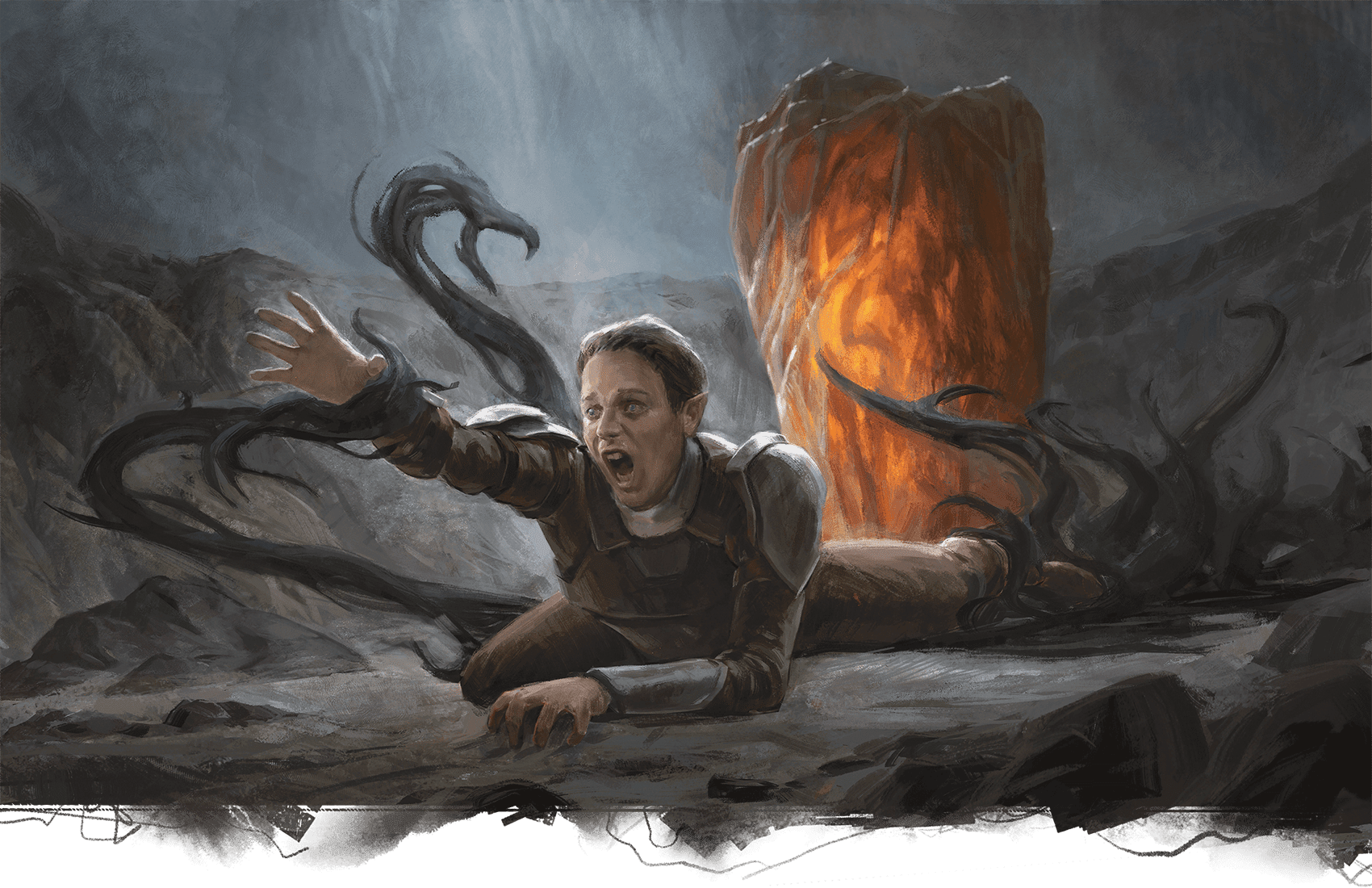
The walls of the cavern undulated with the tortured faces of ghosts who were trapped within the house. At the center of a pool of dark, inky fluid stood an amber monolith. The monolith gave off a terrible light, and a dark entity squirmed within it. As Rolo approached the monolith, the air grew cold and the imperious red-headed woman he had seen in his dreams materialized in spectral form before him. She declared to the monolith that she would sacrifice the interlopers in return for her own freedom!

The ghostly woman plunged her sword into her own stomach and let loose a terrifying wail. Esme dropped immediately at the horrid sound. The rest of the group split their efforts between fending off the ghostly warrior woman and attacking the monolith. Unfortunately, cracking the monolith let loose dark tendrils that also joined the melee. Speaking of joining the melee, a witch flew down the pit to aid the party; she has been summoned by the candle they left lit on the witchstone. Although she managed to do a bit of damage to the shadowy tentacles, she was also knocked unconscious rather quickly.

Ultimately, our heroes carried the day. Ludovico's wand of magic missiles tore through the warrior woman's ghostly form. Rolo kept everyone on their feet with his healing magic. Gnargar shattered the monolith with a combination of kicks and punches. With the monolith destroyed, the inky water in the pool receded, revealing the bones of all who had come before in the attempt to purge the house of evil. Returning to the house proper, the group found it quiet and devoid of ghostly presences; the ghostly children were also absent. 

After recuperating and gathering up their possession, they all ventured outside the house. As they waited for their carriages to return, they saw the ghostly forms of the two children join their mother in the Mists as it receded like the tide pulling away from the shore.

Wednesday, June 22, 2022

Monsters Attack! Issue Two


Monsters Attack! was a short-lived, magazine-sized comic put together by the then-editor of Cracked magazine. Each issue features a number of horror comics, as well as articles about horror movies and all things gruesome. I got my hands on the first issue when it debuted, but the pharmacy I bought it from never seemed to get the following numbers. Now that I have a copy of the Monsters Attack! Ultimate Collection, I plan to go through the series' five-issue run and briefly review the comic content from each issue. I've covered the first issue here, so let's move on to the contents of the second issue.

"Aquacarnivora"

Story by Mort Todd, art by Gray Morrow

A couple guys catch a mermaid and manage to haul her back to an aquarium, somehow without the one guy's girlfriend noticing. Of course, this is a murder mermaid who kills the aquarium owner (and a hapless employee sent to clean the tank), even though the guy has resolved to set her free after he has the experience of swimming with her. The remaining friend decides that it's time to commit mermaid genocide (despite the fact that they kidnapped the mermaid for what was essentially slavery), arming himself with underwater grenades and poison. This is a pretty weird story; didn't really hit the spot.

"It's All in His Mind"

Story and art by Steve Ditko, finishes by Mort Todd

A man experiences the surreal nightmare of literally falling to pieces, both as a mortal of flesh and blood and as a robot. It turns out that he was an anti-robot activist who detonated a bomb to destroy a scientist's automatons--and killed himself in the process. The scientist preserved the activist's brain, keeping it alive in a vat of fluid where his mind continually experiences the horrors of falling apart over and over again. I love that the explosion somehow knocked his undamaged brain clean out of his skull.

"The Outsider"

Adaptation by Bhob Stewart and Steve Harper

This one is an adaptation of H.P. Lovecraft's story of the same name. A nameless ghoul thinks he is climbing a tower, but in reality he is nearly ascending out of a charnel house. The reception he receives when he bursts into a party of revelers is apt, as is his reaction to his own hideous visage in a mirror. Now that I think about it, the story is fairly prescient; it's really the tale of an incel leaving mom's basement, isn't it? Anyway, the artwork in this piece really is stellar; it leans heavily on blacks and negative image and really captures that Weird Tales vibe. That said, apparently the decision to change the original pages to a negative inversion was made by the editor; although it looks cool, I'd hate to think this was presented in a way that the artist didn't intend.

"Abracadaver"

Story and art by Rurik Tyler

This is probably the most intricate story in the issue, and again I think the best has been saved for last. A mortician on the make doesn't want to carve up an unblemished corpse for its organs, despite the presence of an organ donor's card, so he substitutes organs from other corpses so he can use this perfect one for an altogether stranger purpose: he freezes the corpse, then slices it into sections for a Body Worlds-style exhibition. 

Unfortunately for him, the corpse in question belonged to a powerful sorcerer who had planned to take over the bodies of the people who were to be given his organs as transplants. His plan thwarted, he reanimates as slices of his original body that move as one! That is a hell of an idea. The dark, moody art style really works well here.

Note: This issue originally also included an adaptation of Edgar Allan Poe's "The Cask of Amontillado," which is not included in this "Ultimate Collection." That's unfortunate! I wonder if Mort Todd couldn't get the rights to it.

Sunday, June 19, 2022

The House of Lament, Part One

I ran The House of Lament, the adventure included in Van Richten's Guide to Ravenloft, and here's how it went.

The Characters

Rolo, minotaur cleric played by Andrew

Gnargar, kobold monk played by heather

Ludovic the Red, human wizard played by Andrew

Katherine, human bard played by Stefan

Events

Rolo, Gnargar, Ludovic, and Katherine were all hired to investigate the legendarily haunted house known as "the House of Lament" by a mysterious benefactor named Professor Vole. When they arrived at the dark, delipidated three-story house, they discovered that although each of them had been given a key to the front door, its lock required five keys to open. Undeterred, they found an unlocked side entrance and made their way into the house through the debris-strewn kitchen. They also made an odd discovery: there was a freshly baked cake with the oven, despite the oven being cold, covered with dust, and evidencing disuse. 

Exploration of the house was interrupted by the arrival of a fifth investigator: Esme, a Vistani who had brought crates of books, mechanical equipment, and foodstuffs to aid in the endeavor. Esme handed out a few devices that would prove helpful, such as an a spectral voice amplifier, an aurascope, and apparitional goggles. 

Esme also proclaimed that the parlor of the house was warded against malign ghostly intrusion; as a medium, she held several seances in the room so that the characters could question a few of the spirits trapped within the house. Esme told them that she could perceive three entities that were willing to speak to the party, though each only appeared as a dim, shadowy figure: there was a knight, a mother, and a woman who had played three roles over the course of her life--princess, warrior, and revenge seeker.

The group chose to communicate with the mother and the tripartite woman. The spirits answered their queries as best they could, and also sent to exorcise some of the dangerous spirits from the house. They were alerted to the presence of "the Chimney Witch," a spectral hag, and in the confrontation with her a long, many-elbowed arm reached out of the oven and pulled Gnargar into the flames. Nevertheless, she was delt with accordingly and purged from the House of Lament.

They also defeated the ghost of a suicide known as "the Leaper." The Leaper attacked them on the stairs of the house's tower; he used concussive blasts of force, not unlike the wind that would rush by a suicide as they plummeted to their death, to attempt to knock the group off their stairs. Gnargar was again targeted, but a well-placed featherfall spell from Ludovico saved his life. 

At the top of the tower, the group found a set of blood-red ringmail armor that was curiously unaffected by exposure to the elements. The armor lay within a strange symbol that was later identified as the insignia of the Keepers of the Feather. Rolo donned the armor and felt a spectral presence near at hand, watching over him.

The group were also in pursuit of a witch stone, a rune-inscribed flat stone that was held by local superstition to discourage witches from laying a curse upon one's house. The witch stone remained unfound as they closed their first night of exploration.

They made their sleeping arrangements in the parlor. Although the parlor seemed safe from ghostly attacks, it did not protect the group from bad dreams. One dreamt of a knight wearing a skull-faced helm laughing and lounging on a throne as his subordinates walled a man inside an alcove; one dreamt of a woman in blood-red armor forcing her soldiers to march toward a castle on a hill in the midst of a terrible storm; one dreamt of the same woman on her knees, howling into the night as shadows consumed her; one dreamt of the woman in blood-red armor running a sword through the knight with the skull-faced helmet and then going on a murderous rampage, killing everyone she could find in the castle.

What do these dreams signify? Where is the witch stone? Perhaps we will find out, if there is a reprise for this adventure.